
What Is an Apple 21.5-27 Inch iMac NVIDIA Dedicated Graphics Logic Board?
An Apple 21.5-27 inch iMac NVIDIA dedicated graphics logic board is the main printed circuit assembly removed from selected Intel-based all-in-one desktop systems equipped with discrete NVIDIA graphics. In scrap identification, this name usually refers to logic boards from thin-profile 21.5 inch and 27 inch iMac models that use Intel desktop-class processors, DDR3 memory architecture, and a separate NVIDIA graphics processor rather than relying only on integrated graphics.
This board is not a generic desktop motherboard. It is a custom-shaped, high-density logic board designed for a compact all-in-one chassis. The board integrates CPU power delivery, GPU circuitry, system memory connections, storage interfaces, display pathways, audio, Ethernet, USB, Thunderbolt, wireless-card connections, sensors, and multiple proprietary cable sockets. Because many of these components use gold-plated contacts, copper-rich power circuits, multilayer PCB construction, and semiconductor packages, complete iMac logic boards are normally considered valuable electronic scrap.
The most important identification point is that “21.5-27 inch iMac NVIDIA dedicated graphics logic board” is a board family description rather than one single universal board. The 21.5 inch and 27 inch versions are physically different. The late 2012 NVIDIA versions commonly use Intel 3rd generation Core processors with an LGA1155 CPU interface. The late 2013 NVIDIA versions use Intel 4th generation Core processors with an LGA1150 CPU interface. These sockets are not interchangeable, even though both CPU package families use a 37.5 mm × 37.5 mm land-grid-array processor package. For scrap sorting, this distinction matters because socket generation, GPU package type, memory layout, and board completeness affect identification and value.
Basic Board Identification
A complete iMac NVIDIA dedicated graphics logic board can usually be identified by its irregular Apple-specific board outline, large CPU socket or CPU mounting area, dedicated NVIDIA GPU package or GPU module area, DDR3 SO-DIMM memory slots, multiple board-to-board and board-to-cable connectors, and dense voltage-regulation sections near the processor and graphics circuit.
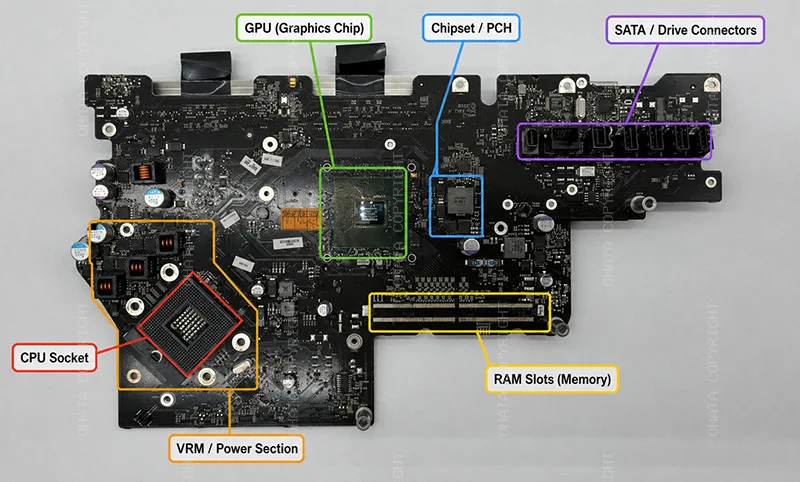
2010 Apple 21.527 Inch iMac NVIDIA Dedicated Graphics Logic Board Show All Parts
Common physical identification features include:
- CPU socket or CPU retention area
- NVIDIA GPU BGA package or dedicated graphics assembly area
- GDDR5 video memory chips around the GPU area
- DDR3 SO-DIMM slots or memory interface area
- Thunderbolt controller circuitry
- USB 3.0 controller and rear I/O solder points
- SATA storage connectors or storage flex connectors
- LCD/eDP or display cable connector
- Camera, speaker, microphone, fan, and sensor connectors
- Wireless card socket or cable interface
- Copper inductors, MOSFETs, tantalum capacitors, and ceramic capacitors
- Large heatsink mounting holes around the CPU and GPU zones
Compared with standard desktop motherboards, the iMac logic board has fewer expansion slots and more proprietary internal connectors. It is designed to fit behind the display panel, so the layout is compact and highly customized. The absence of PCIe card slots does not mean the board is low grade. Its value comes from its dense components, high-quality connectors, multilayer PCB, CPU interface, GPU package, video memory, and power management sections.
CPU Interface Type and CPU Size
The CPU interface must be confirmed carefully because not all NVIDIA iMac logic boards use the same socket generation.
For late 2012 21.5 inch and 27 inch NVIDIA dedicated graphics iMac logic boards, the CPU interface is Intel LGA1155, also called Socket H2. This is a land grid array socket used with 3rd generation Intel Core desktop processors. The processor package size for the LGA1155 family is 37.5 mm × 37.5 mm. This measurement refers to the overall processor package substrate, not the silicon die under the integrated heat spreader.
For late 2013 NVIDIA dedicated graphics iMac logic boards, the CPU interface changes to Intel LGA1150, used with 4th generation Intel Core desktop processors. The LGA1150 processor package size is also 37.5 mm × 37.5 mm. Although the physical package size is the same, LGA1155 and LGA1150 are electrically and mechanically different socket families and should not be treated as interchangeable parts.
In scrap identification, a board with a visible LGA socket and intact CPU retention mechanism is generally easier to classify. If the CPU has been removed, the socket pins should still be inspected. Bent, crushed, corroded, or missing socket pins reduce reuse potential and may reduce the board’s resale value as a repair part, although the board may still retain scrap metal value.
NVIDIA Dedicated Graphics Section
The NVIDIA dedicated graphics section is one of the most important value and identification zones on this type of board. Depending on model year and screen size, these boards may include NVIDIA GeForce GT, GTX, or mobile-class graphics processors paired with dedicated GDDR5 video memory. Examples associated with this iMac category include GeForce GT 640M, GT 650M, GTX 660M, GTX 675MX, GTX 680MX, GT 750M, GT 755M, GTX 775M, and GTX 780M configurations.
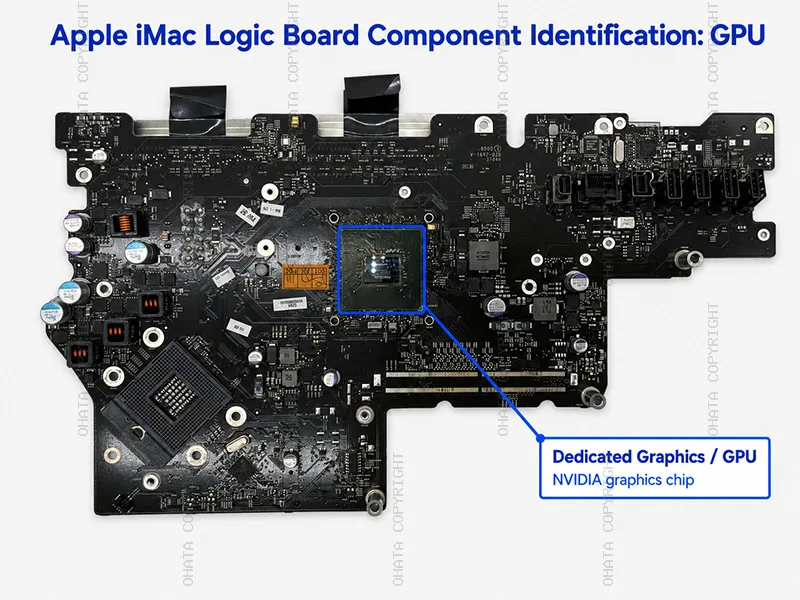
2010 Apple 21.527 Inch iMac NVIDIA Dedicated Graphics Logic Board GPU NVIDIA
A dedicated GPU section can usually be recognized by a large BGA chip package, a surrounding cluster of small rectangular GDDR5 memory ICs, heavy copper thermal pads or heatsink contact areas, and a nearby group of power inductors and MOSFETs. The GPU may be soldered to the logic board or arranged in a board-specific graphics module layout depending on the exact iMac version. The 27 inch boards often have higher-end graphics configurations than the 21.5 inch boards, and the higher-capacity GPU memory configurations may have greater component recovery interest.
From a scrap perspective, the GPU area is valuable because it contains semiconductor material, copper interconnects, package substrate materials, solder balls, and nearby precious-metal-bearing connections. The surrounding video memory chips add additional semiconductor and copper value. Boards with the original GPU and video memory still present are more desirable than boards where the graphics package has been removed, heat-damaged, or reworked.
Memory Interface and RAM Slot Identification
The memory architecture in this board family is based on DDR3 SO-DIMM memory. The 27 inch versions commonly have user-accessible SO-DIMM slots, while 21.5 inch versions may use a more restricted internal memory arrangement depending on model. For scrap identification, the important factor is whether the memory slots, contacts, and any installed memory modules remain intact.
SO-DIMM slots contain fine gold-plated contacts. If removable RAM modules are still installed, they should be separated only when the recycling or resale process calls for component-level sorting. Functional RAM modules may have reuse value, while non-working modules still contain gold-plated edge fingers and IC packages.
Boards with intact memory slots are normally more complete and easier to grade. Missing, cracked, burned, or desoldered memory slots reduce component completeness. Heavy mechanical damage near the RAM area can also indicate rough dismantling, which may reduce repair-part value even when scrap material value remains.
Storage and Internal Drive Interfaces
Apple 21.5-27 inch iMac NVIDIA logic boards may include SATA storage interfaces for hard drives or solid-state storage, and some configurations support Fusion Drive arrangements that combine flash storage and hard drive storage at the system level. Exact connector shape varies by model year and board revision.
Typical storage-related features may include:
- SATA data connector
- SATA power connector or flex cable socket
- SSD blade connector on certain configurations
- Hard-drive temperature or sensor cable connector
- Power and signal traces leading to storage zones
These connectors contain copper contacts and may contain small amounts of precious-metal plating. Storage connectors are also important for board completeness. A board with missing storage sockets, torn flex connectors, or damaged solder pads is less desirable as a repair board and may be downgraded to material recovery only.
If an SSD blade, hard drive, or other storage device is still attached, it should be handled separately according to data-security and battery-free electronic scrap procedures. Storage devices should not be confused with the logic board itself when grading a motherboard lot.
Rear I/O and External Interface Components
The rear I/O section contains many of the easiest visible identifiers. Depending on model year, a typical NVIDIA iMac logic board may provide USB 3.0 ports, Thunderbolt ports, Gigabit Ethernet, an SDXC card slot, audio output, and display-related external support through Thunderbolt or Mini DisplayPort-compatible signaling.
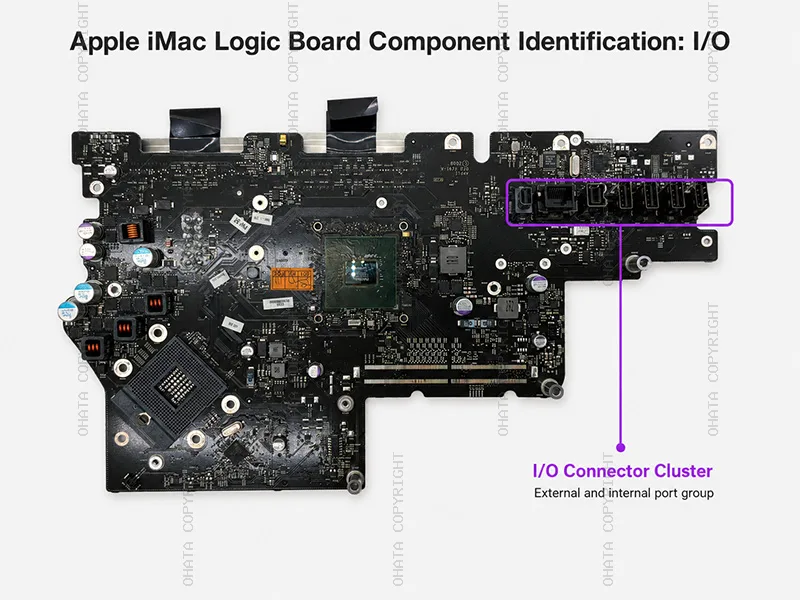
2010 Apple 21.527 Inch iMac NVIDIA Dedicated Graphics Logic Board IO Connector Cluster
Important rear I/O components include:
- USB 3.0 port assemblies
- Thunderbolt port assemblies
- RJ-45 Ethernet jack
- SDXC card reader connection
- Audio jack
- Antenna and wireless-related connections
- Shielded metal port housings
- Rear I/O solder joints and grounding pads
These ports contain copper, nickel plating, steel shielding, and small amounts of gold plating in contact areas. Thunderbolt-related circuitry is especially useful for identification because NVIDIA iMac logic boards from this era often use Thunderbolt as a major display and expansion pathway. The port housings themselves are not the highest precious-metal-value items, but intact I/O connectors improve grading and help confirm the board type.
Display, Camera, Audio, Fan, and Sensor Connectors
Because this board is used inside an all-in-one desktop, many internal connectors are dedicated to the display assembly and chassis components. These include display data connectors, LED backlight or display power pathways, camera cable sockets, microphone and speaker connectors, fan connectors, temperature sensor connections, and power button or diagnostic LED connections.
These connectors are usually small, delicate, and easily damaged during dismantling. For scrap material recovery, each connector contributes a small amount of copper and plated contact material. For repair resale, however, connector condition is critical. A logic board with torn display connectors, missing latch bars, ripped pads, or broken fan sockets may no longer be suitable for repair use and should be graded mainly as scrap.
When identifying these boards, the display connector area is especially important. iMac logic boards have distinctive display pathways that are not found on ordinary tower PC motherboards. A board with the display cable socket, backlight/power connector, and camera/audio cable sockets still attached is more likely to be classified accurately.
Power Delivery Components
The power delivery system is one of the densest and most material-rich areas of the board. It includes voltage regulator modules for the CPU, GPU, memory, PCH, storage, Thunderbolt, USB, and auxiliary system rails. These circuits usually contain copper inductors, MOSFETs, driver ICs, tantalum capacitors, multilayer ceramic capacitors, and high-current PCB traces.
Major power-section scrap components include:
- Copper inductors and coils
- MOSFETs and voltage regulator ICs
- Tantalum capacitors
- Ceramic capacitors
- Power management controllers
- High-current copper traces
- Heatsink mounting and grounding zones
Copper is one of the main recoverable materials in motherboard recycling. The iMac NVIDIA logic board is especially attractive because the dedicated GPU requires its own high-current power circuitry in addition to the CPU power system. A complete board with CPU and GPU power circuits intact is usually more valuable than a stripped board where inductors, MOSFETs, or capacitors have been removed.
Burn marks in the power area should be noted. Light discoloration may not heavily affect material value, but severe charring, melted connectors, missing pads, or lifted copper layers may reduce grade and handling safety.
Chipsets, Controllers, and Firmware ICs
In addition to the CPU and GPU, the board contains several controller and support ICs. These may include the platform controller hub, Thunderbolt controller, Ethernet controller, audio codec, USB-related controller circuitry, system management controller, BIOS/EFI flash memory, clock generators, sensor controllers, and power sequencing chips.
These small ICs are valuable mainly as part of the whole board’s high-grade electronic scrap composition. Some firmware chips may also have repair or harvesting value, especially if they are intact and correctly matched to a board revision. However, removing individual small ICs is usually not recommended unless the recycler has a specific component-level process.
The platform controller hub is especially important. It connects CPU, storage, USB, audio, network, and other system pathways. A board with the PCH present is more complete than one that has been stripped. Heat-damaged or missing chipsets may downgrade the board from repair-grade to scrap-grade.
PCB Construction and Recoverable Materials
The iMac NVIDIA dedicated graphics logic board is a multilayer printed circuit board. It contains fiberglass-reinforced epoxy substrate, copper layers, solder mask, solder alloys, plated through-holes, surface-mount pads, and dense internal signal routing. Because the board supports a desktop-class CPU and dedicated GPU, the PCB contains significant power and ground planes.
Recoverable materials may include:
- Copper from PCB layers, traces, coils, and connectors
- Gold from socket contacts, memory contacts, and plated connectors
- Nickel from connector plating and shielding
- Tin and solder alloys from surface-mount joints
- Tantalum from capacitors
- Aluminum from attached heatsink fragments if present
- Steel from shields, brackets, screws, and port housings
- Silicon and package materials from CPUs, GPUs, memory ICs, and controllers
The PCB itself should not be treated as low-grade appliance board scrap. A complete iMac logic board with CPU socket, GPU, memory slots, connectors, and power components is generally closer to a high-grade computer motherboard category than to low-grade peripheral board scrap.
Accepted Materials
For recycling and scrap identification, acceptable iMac NVIDIA logic board material generally includes complete or partially complete logic boards removed from compatible 21.5 inch and 27 inch iMac systems.
Accepted board conditions may include:
- Complete logic boards with CPU socket and GPU present
- Boards with attached CPU, if applicable
- Boards with NVIDIA GPU and GDDR5 memory chips present
- Boards with RAM slots and connectors intact
- Boards with Thunderbolt, USB, Ethernet, and audio ports present
- Boards with PCH, controller ICs, and firmware chips present
- Boards with normal dust or light cosmetic wear
- Boards with minor screw marks or non-critical edge wear
- Boards with original heatsink brackets or small metal shields still attached
Complete boards are preferred because they preserve the highest concentration of recoverable components and are easier to identify. A board should not be unnecessarily stripped before shipment unless a component-level recycling process has been agreed in advance.
Not Accepted Materials
The following materials should generally be removed or separated before grading and shipment:
- Lithium-ion batteries
- Swollen or damaged batteries
- Loose glass from display panels
- Large plastic housings
- LCD panels mixed with logic boards
- Power cords and unrelated cables
- Oil-contaminated or liquid-soaked parts
- Loose trash, paper, foam, and packaging waste
- Mercury-containing devices
- Unrelated appliance boards mixed into the same lot
- Heavily burned material with unsafe residue
CMOS coin-cell batteries, if present, should be handled according to battery recycling requirements. Batteries should not be included as ordinary motherboard scrap. Removing non-board materials improves grading accuracy, reduces handling risk, and prevents a high-grade motherboard lot from being downgraded due to contamination.
Preparation Tips for Scrap Value
To preserve value, suppliers should keep iMac NVIDIA logic boards clean, dry, and separated from lower-grade mixed electronic scrap. Boards should be stacked carefully to prevent socket pin damage, broken connectors, and crushed BGA packages.
Recommended preparation steps include:
- Remove loose batteries and unrelated display glass
- Keep CPU, GPU, PCH, RAM slots, and connectors intact when possible
- Do not pry off BGA chips with heat or force
- Avoid cutting the board unless required for a specialized process
- Separate 21.5 inch and 27 inch boards when model identification is needed
- Separate NVIDIA dedicated graphics boards from integrated-graphics-only boards
- Protect CPU socket pins with the retention cover if available
- Avoid mixing wet, corroded, or burned boards with clean boards
- Package boards flat to prevent bending during transport
Unnecessary dismantling often reduces repair resale potential and may also reduce scrap grade. Component-level recovery should be done only when the processor, RAM, GPU, connectors, and high-value parts can be sorted into clean material categories without damaging the remaining board stream.
Value Factors
The value of an Apple 21.5-27 inch iMac NVIDIA dedicated graphics logic board depends on both material recovery value and possible reuse value.
Key value factors include:
- CPU present or socket intact
- NVIDIA GPU present and not heat-damaged
- GDDR5 video memory chips present
- RAM slots intact
- PCH and controller ICs present
- Thunderbolt and USB connectors present
- Gold-plated contacts not removed
- Copper inductors and power circuits intact
- Board not cracked or cut
- No heavy corrosion or liquid damage
- No severe burn damage
- Correct identification by screen size, model year, and socket generation
A complete 27 inch NVIDIA board may have stronger recovery interest than a lower-end 21.5 inch board because it can include higher-performance GPU configurations and larger memory support. However, exact value cannot be determined by screen size alone. Board condition, model year, component completeness, and current processing demand all matter.
A board with minor dust or missing screws is usually still acceptable. A board with minor cosmetic wear may still be acceptable if the main CPU socket, NVIDIA graphics section, memory connectors, PCH, power components, and board-to-cable connectors remain intact.
However, when a board has been aggressively stripped, the remaining PCB may lose much of its identification value and may be graded only by base board material rather than by complete logic board category.
The back side of the board is also important, but it usually shows a different type of value. It may contain solder joints, smaller ICs, copper traces, mounting brackets, retention structures, test points, and rear solder points for larger connectors. The back side helps confirm board condition, liquid exposure, repair history, and whether components have been removed from the opposite side.
Back-side inspection should look for:
- Burn marks behind the CPU or GPU area
- Missing BGA solder pads
- Lifted copper traces
- Corrosion around connector pins
- Cracked solder joints
- Bent board corners
- Evidence of rework or overheating
- Broken mounting holes
A clean back side with no major corrosion or rework damage supports a higher grade. A back side with large burned areas, missing pads, or heavy oxidation indicates lower repair value and may affect scrap handling.
Interface and Connector Parameter Summary
These interface categories are more useful for scrap identification than a single board number alone, because iMac boards can appear in multiple revisions. A board should be identified by socket type, GPU type, screen-size layout, memory-slot arrangement, and connector pattern.
A board with some missing parts, such as removed CPU, missing RAM, or minor connector damage, but still retaining GPU, PCH, power components, and most connectors.
It should also not be confused with older 2009-2011 iMac logic boards that may use different GPU architectures, different internal layouts, or different processor generations. Some older iMac models used graphics modules or non-NVIDIA configurations, so the board must be inspected physically rather than identified only by screen size.
The Apple 21.5-27 inch iMac NVIDIA dedicated graphics logic board is a high-density, high-grade computer logic board used in selected Intel-based iMac systems with discrete NVIDIA graphics. Its scrap value comes from the combination of a desktop-class Intel CPU interface, dedicated NVIDIA graphics processor, GDDR5 video memory, DDR3 memory architecture, Thunderbolt and USB interface circuitry, gold-plated contacts, copper-rich power delivery components, and multilayer PCB construction.
For technical identification, the CPU interface must be confirmed by generation. Late 2012 NVIDIA iMac logic boards use Intel LGA1155, while late 2013 NVIDIA iMac logic boards use Intel LGA1150. In both cases, the CPU package size is 37.5 mm × 37.5 mm. This measurement is important because it confirms the processor package family, but it does not make the two socket types interchangeable.
For scrap grading, complete boards with the CPU socket, NVIDIA GPU, GDDR5 memory, PCH, RAM slots, connectors, and power components intact have the strongest recovery potential. Boards with missing GPU packages, stripped connectors, damaged sockets, liquid corrosion, or heavy burn damage should be downgraded. Batteries, glass, plastic housings, and unrelated waste should be removed before shipment.
A careful inspection of socket type, GPU presence, connector completeness, power circuitry, and board condition allows this iMac logic board to be separated from lower-grade electronic scrap and properly classified as a valuable computer motherboard for reuse, component recovery, or precious-metal-bearing e-waste processing.