
What Is Lenovo H10X02I ThinkCentre M720q M920q Tiny Mini PC Series Motherboard Scrap?
Lenovo H10X02I ThinkCentre M720q M920q Tiny Mini PC series motherboard scrap refers to discarded, damaged, obsolete, incomplete, or non-working motherboards removed from Lenovo ThinkCentre Tiny-series mini desktop computers. The H10X02I marking is commonly associated with compact ThinkCentre M720q Tiny and M920q Tiny system boards used in one-liter business-class mini PCs. These boards are physically smaller than standard desktop motherboards but still contain high-value electronic components such as an Intel desktop CPU socket, platform controller hub, DDR4 memory support, M.2 storage interface, SATA interface, high-density voltage regulation circuitry, USB ports, Ethernet port, firmware ROM, and multiple gold-plated connectors.
This motherboard is especially important in scrap identification because it is not a simple low-grade peripheral board. It is a complete mini PC motherboard built around an Intel Coffee Lake / Coffee Lake Refresh platform. Depending on the host system configuration, the same board family may be found in systems using Intel B360 or Intel Q370 chipsets. The ThinkCentre M720 Tiny platform is specified with Intel B360 chipset, while the ThinkCentre M920 Tiny platform is specified with Intel Q370 chipset. Both platforms support 8th and 9th generation Intel desktop processors in low-power T-series configurations, making the board more valuable than many small appliance, router, monitor, or power-supply boards.
From a recycling perspective, the board has value because it contains copper traces, multilayer PCB copper, soldered semiconductor chips, gold-plated socket contacts, gold-plated connector contacts, nickel-plated I/O ports, aluminum electrolytic capacitors, ferrite and copper inductors, MOSFETs, ceramic capacitors, and other recoverable materials. Complete boards with original ICs intact are normally more desirable than heavily stripped boards. For scrap grading, the presence or absence of the CPU, chipset/PCH, BIOS ROM, M.2 connector, SATA connector, USB ports, Ethernet port, and voltage regulator components can significantly affect inspection results.
Motherboard Identification
The H10X02I board can be identified by its compact square/rectangular Tiny-series PCB layout, Lenovo branding, LGA1151 CPU socket, M.2 SSD connector, coin-cell battery holder, high-density power circuitry, multiple USB Type-A ports, Ethernet port, and rear I/O connector cluster. The board shown in the uploaded image has the CPU socket visible on the front side, a large BGA chipset/PCH package to the right of the CPU socket, a visible M.2 SSD connector near the right edge, a SATA cable connector near the lower-right section, several USB ports along the lower edge, and rear I/O shielding at the upper edge.
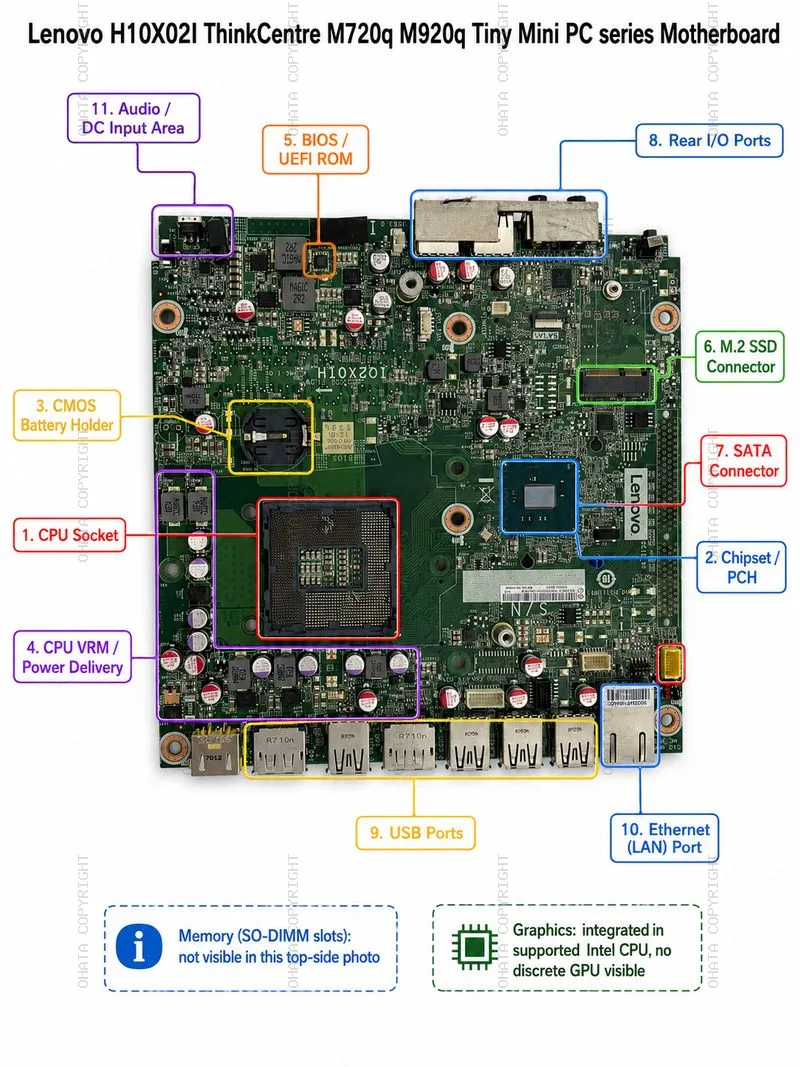
2019 Lenovo H10X02I ThinkCentre M720q M920q Tiny Mini PC Series Motherboard Show All
The board should be identified as a mini desktop motherboard rather than a laptop motherboard. Although it uses notebook-style SO-DIMM memory modules in the complete system, the processor interface is a socketed desktop-style Intel LGA package rather than a soldered mobile BGA CPU. This is an important scrap identification point. Many laptop motherboards have soldered BGA CPUs and GPUs, while this board has a replaceable LGA1151 CPU socket. The integrated graphics function is not a separate graphics chip on the motherboard. Instead, Intel UHD Graphics 610 or Intel UHD Graphics 630 is integrated into the compatible Intel processor, depending on the CPU installed.
The motherboard should not be confused with standard ATX, microATX, or mini-ITX desktop boards. The ThinkCentre Tiny board is a proprietary small-form-factor board designed for a compact chassis. It has custom board geometry, custom mounting points, compact I/O layout, and space-saving internal connectors. These features make it useful for reuse and repair but also require careful sorting because it may not fit standard PC cases.
CPU Interface and Processor Support
The CPU interface is one of the most important identification features of this motherboard. The board uses an Intel LGA1151 socket for compatible 8th and 9th generation Intel desktop processors. The socket type is LGA, meaning “land grid array.” In this design, the socket contains the contact pins, while the processor package has flat contact pads. It is not a PGA socket, and it is not a soldered BGA CPU. The package size for compatible LGA1151 Coffee Lake processors such as the Intel Core i9-9900T is 37.5 mm × 37.5 mm.
This CPU size should be recorded in scrap identification because it helps distinguish this board from smaller soldered mobile CPU platforms and from larger server CPU platforms. The CPU socket has a high density of gold-plated contact points and is one of the visually important value-bearing areas of the motherboard. If the socket is damaged, burned, contaminated, or missing, the board may be downgraded.
The ThinkCentre M720 Tiny and M920 Tiny platforms support a range of Intel 8th and 9th generation CPUs, including Celeron, Pentium Gold, Core i3, Core i5, Core i7, and selected Core i9 T-series processors. Official platform specifications list support for processors up to Core i9-9900T on compatible configurations. Typical compatible CPUs include Intel Celeron G4900T/G4930T, Pentium Gold G5400T/G5420T, Core i3-8100T/9100T, Core i5-8400T/9400T/9500T, Core i7-8700T/9700T, and Core i9-9900T, depending on BIOS, board revision, thermal solution, and power adapter.
The Core i9-9900T is an 8-core, 16-thread Coffee Lake Refresh processor with a 35 W TDP, 2.10 GHz base frequency, up to 4.40 GHz maximum turbo frequency, 16 MB cache, DDR4-2666 memory support, Intel UHD Graphics 630, and FCLGA1151 socket support. Lower-end CPU options may include Intel UHD Graphics 610 or UHD Graphics 630 depending on the exact processor. Because the graphics engine is inside the CPU package, a removed CPU also means the integrated graphics processor is absent.
For scrap buyers, a board with the CPU still installed can be more valuable than a bare board, especially if the processor is a higher-tier Core i5, Core i7, or Core i9 T-series model. A board with the CPU removed still contains recoverable material, but it loses resale, testing, and component recovery value.
Chipset / PCH
The chipset or platform controller hub is a large soldered BGA IC located near the right side of the board in the uploaded front-side image. It should not be identified as a discrete GPU. On this platform, the visible large BGA package is best treated as the chipset/PCH area. The M720 Tiny platform is associated with Intel B360 chipset, while the M920 Tiny platform is associated with Intel Q370 chipset.
The PCH manages key system functions such as storage, USB, PCIe connectivity, firmware communication, and other platform I/O functions. It is soldered directly to the PCB using a BGA package. BGA means “ball grid array,” where small solder balls under the chip connect it to the motherboard. A removed PCH leaves a rectangular footprint with exposed pads and is a serious downgrade condition for recycling and reuse.
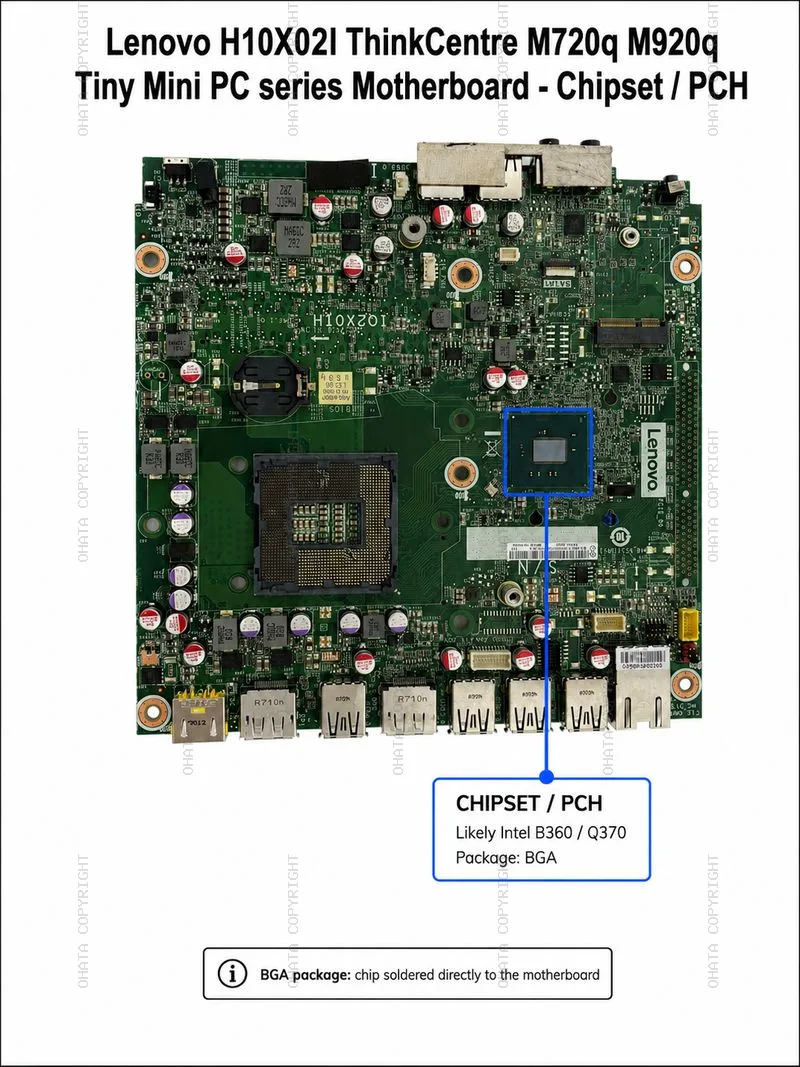
2019 Lenovo H10X02I ThinkCentre M720q M920q Tiny Mini PC Series Motherboard Chipset
For scrap grading, the PCH is one of the most important semiconductor components on the board. Boards with removed chipset ICs should be considered incomplete. If the chipset is missing, physically cracked, heat-damaged, desoldered, or mechanically scraped off, the board should be downgraded or rejected depending on the buyer’s acceptance rules. Complete boards should retain the chipset/PCH, BIOS ROM, power ICs, and major connectors.
Memory Support
The ThinkCentre M720 Tiny and M920 Tiny platforms use DDR4 SO-DIMM memory, not full-size desktop DIMM modules. Official specifications list two DDR4 SO-DIMM slots, dual-channel capable, with up to 32 GB DDR4-2666 memory support. Lower-end processors may run memory at a lower effective speed depending on the CPU memory controller. The board shown in the uploaded front-side image does not clearly show the memory slots on the visible side, so the SO-DIMM slots may be located on the opposite side or obscured by board layout.
Memory type is important for scrap identification. This is a DDR4 platform, not DDR3 and not DDR5. DDR4 SO-DIMM slots contain gold-plated contacts and are useful value-bearing components when present and undamaged. If memory modules are still installed, they should be removed, tested, and graded separately when reuse is possible. Functional DDR4 SO-DIMM modules may have resale value greater than their material value.
A complete motherboard with intact memory slots is generally preferred. Missing, cracked, or desoldered memory slots can reduce board value because they remove gold-plated contact material and reduce the possibility of functional reuse. If the memory slots are on the back side, both sides of the motherboard should be inspected before grading.
Graphics Function
This motherboard does not show a separate dedicated GPU chip in the uploaded image. The graphics function is integrated into the supported Intel CPU. Depending on processor configuration, the board may use Intel UHD Graphics 610 or Intel UHD Graphics 630. Official platform specifications describe integrated graphics output through onboard ports, with support for multiple displays depending on processor and optional rear I/O configuration.
Because the GPU is integrated inside the CPU package, the correct scrap identification statement is: “Graphics: integrated in supported Intel CPU.” It should not be marked as a separate soldered GPU unless a different board variant with a dedicated graphics chip is physically present. In this uploaded board image, the large square blue-green IC to the right of the CPU socket should be treated as the PCH/chipset rather than a discrete graphics processor.
This distinction matters because laptop and all-in-one motherboards may contain separate NVIDIA, AMD, or Apple graphics BGA chips, while this Tiny-series board normally relies on Intel integrated graphics. A removed CPU means both the CPU and integrated GPU are missing. A removed chipset/PCH means the board is also incomplete. For recycling acceptance, both the socket area and PCH area should be inspected carefully.
Storage Interfaces
The board supports compact storage interfaces suitable for a small one-liter system. Official ThinkCentre Tiny platform specifications list one M.2 SSD slot and one 2.5-inch disk bay in the complete system. The M.2 SSD interface supports 2242 or 2280 form factor NVMe SSDs depending on configuration, while the 2.5-inch bay connects through SATA.
The visible M.2 SSD connector on the board is an M.2 Key M-style connector used for SSD installation. It contains fine gold-plated contacts and should remain intact. The M.2 connector is a value-bearing component because of its precious-metal-plated contacts and because it supports reuse. Boards with torn-off M.2 connectors or damaged connector pins may be downgraded.
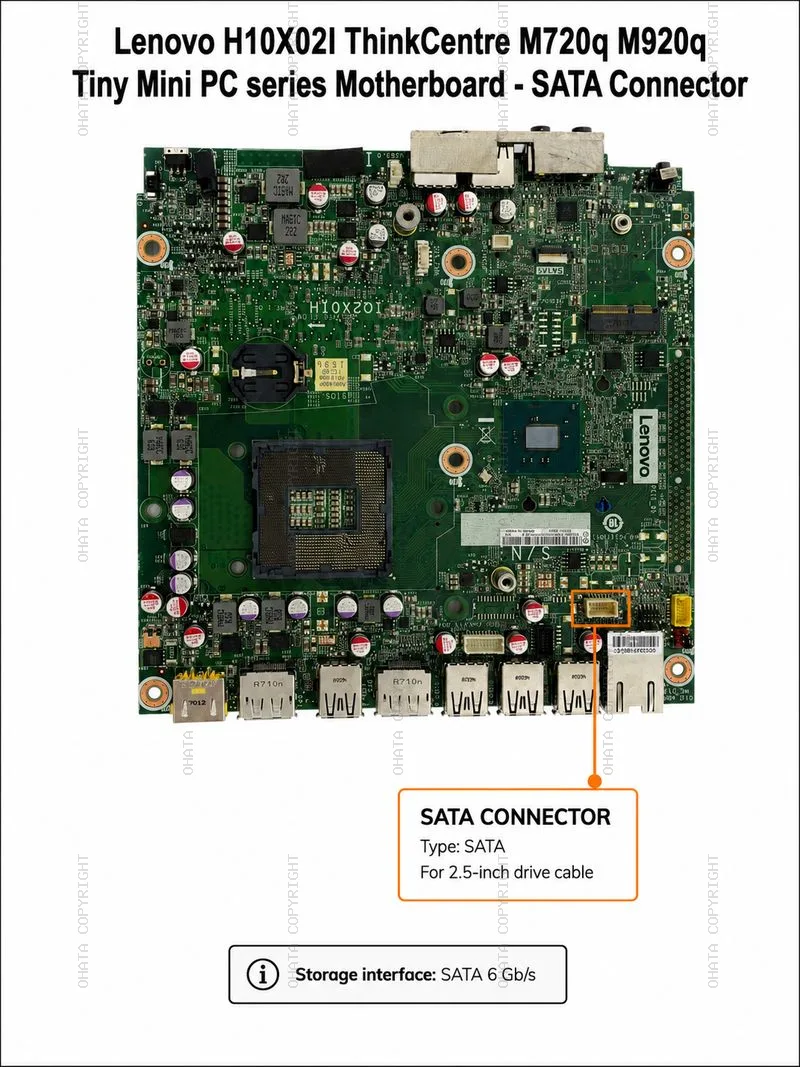
2019 Lenovo H10X02I ThinkCentre M720q M920q Tiny Mini PC Series Motherboard SATA CONNECTOR
The SATA connector visible near the lower-right portion of the board is used for a 2.5-inch SATA drive cable in the complete system. SATA 6 Gb/s storage support is typical for this platform. The SATA connector is smaller than standard desktop SATA ports because the Tiny chassis uses a compact cable assembly. This connector has lower value than the CPU socket or chipset, but it remains important for board completeness.
The platform may also include an M.2 WLAN slot for Wi-Fi/Bluetooth modules in complete systems. Official specifications list two M.2 slots: one for WLAN and one for SSD. If a wireless card is present, it may be removed and sorted separately. If the antenna wires or WLAN module are missing, this does not usually reduce base board scrap value as much as missing chipset, CPU socket, or major power circuitry.
Expansion Slot and PCIe Design
One of the distinctive features of the ThinkCentre Tiny platform is the availability of a low-profile PCIe expansion option in many configurations. The M720 Tiny specification lists one PCIe 3.0 x8 low-profile expansion slot, with two M.2 slots for WLAN and SSD. This gives the board more expansion capability than many ultra-compact mini PCs that rely only on soldered interfaces.
The PCIe expansion feature is important for reuse and repair markets because it can support specific Lenovo-compatible riser cards, network cards, serial cards, or other low-profile options. It should not be confused with a standard full-length PCIe x16 gaming graphics slot. The Tiny chassis has strict height, length, cooling, and power limitations. In many configurations, a 2.5-inch drive bay and PCIe expansion card may be mutually exclusive.
For scrap identification, the PCIe area and edge connector area should be checked for missing pins, broken riser connectors, corrosion, or removed gold-plated contacts. Gold-plated contacts and fine connector pins contribute to recycling value, while intact expansion capability increases reuse value.
Rear I/O Ports and External Connectors
The uploaded board shows a dense I/O edge with multiple USB Type-A ports, Ethernet port, rear display/output area, audio or DC input area, and compact optional connectors. Official platform specifications list common external interfaces such as DisplayPort, HDMI, optional video port, USB ports, Ethernet, and audio depending on the system configuration.
USB Type-A ports contain metal shells, copper alloy contacts, nickel plating, and small amounts of precious-metal plating on contact surfaces. Ethernet RJ-45 ports contain copper contacts and often integrated magnetics. HDMI and DisplayPort connectors include fine contact arrays with plated surfaces. Audio and DC input areas may contain copper, nickel, and steel parts.
For recycling, these connectors are generally not removed individually unless processing at scale. However, they are useful for grading because intact ports indicate a complete board. Ports that are crushed, ripped off, or heavily corroded reduce reuse potential and may lower grade. If I/O shields or metal covers are still attached, they may contribute small amounts of steel or plated metal but are less valuable than semiconductor ICs and gold-contact connectors.
Power Delivery and VRM Area
The CPU VRM and power delivery area is located around the CPU socket, especially along the lower and left side of the socket in the uploaded image. This area includes MOSFETs, driver ICs, inductors, capacitors, resistors, and multilayer copper traces. It converts incoming board power into stable low-voltage power rails required by the CPU and other components.
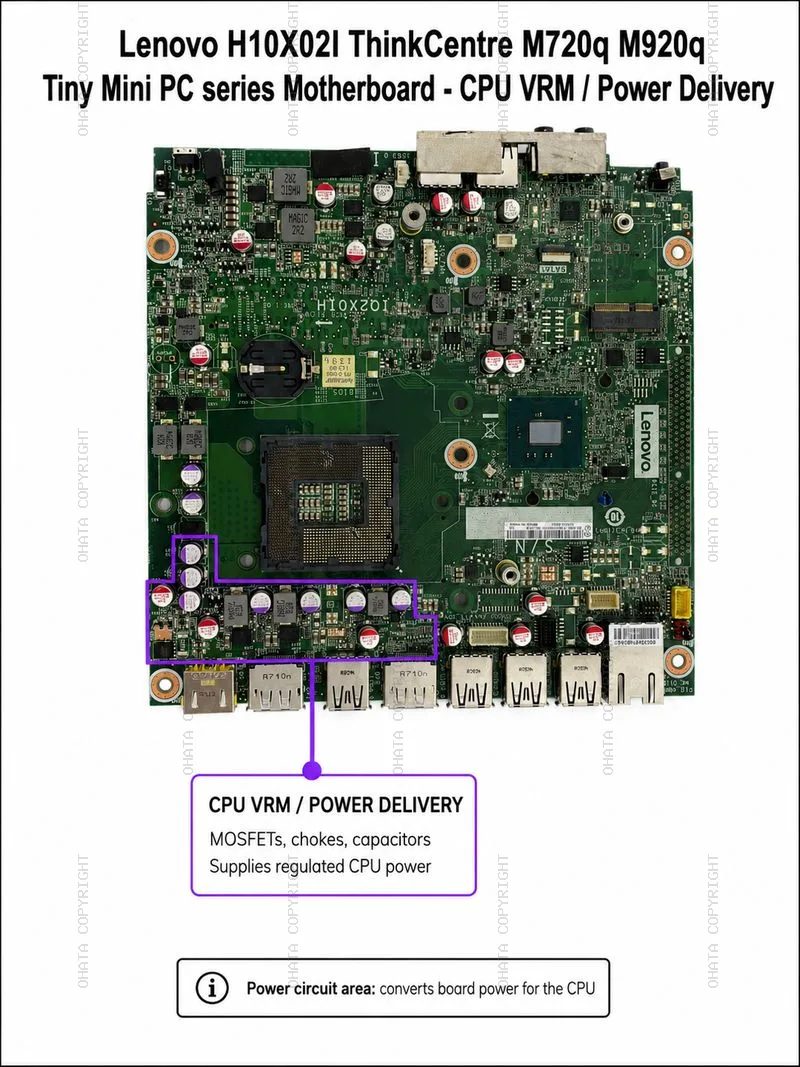
2019 Lenovo H10X02I ThinkCentre M720q M920q Tiny Mini PC Series Motherboard VRM Power Delivery
The VRM area is important for both repair and scrap value. Inductors contain copper windings or ferrite/copper structures. MOSFETs and power management ICs contain semiconductor material and metal lead frames. Capacitors may include aluminum, polymer, or ceramic material depending on type. The copper density near the VRM area is often higher than in simple low-grade electronic boards.
Boards with burned VRM sections, missing coils, removed MOSFETs, or heat-damaged PCB laminate should be downgraded. Burn marks near the CPU socket can indicate severe electrical failure. Even if the board is not functional, intact VRM components contribute to material recovery. For acceptance, the main power components should not be intentionally stripped before shipment unless the buyer requests component-level sorting.
BIOS / UEFI ROM and Firmware Components
The BIOS or UEFI ROM is a small serial flash memory IC located near the board’s firmware area. This chip stores boot firmware required for system initialization. It is physically small, but it is important for repair and board completeness. If the BIOS ROM is missing, the board may not boot even if the CPU, memory, and chipset are intact.
From a scrap perspective, the BIOS ROM has modest material value compared with the CPU socket or chipset, but it can be useful for component harvesting, repair, or firmware recovery. Missing firmware chips, damaged pads, or signs of poor rework can reduce reuse value. Buyers inspecting boards for refurbishment potential should check whether the BIOS ROM remains installed.
CMOS Battery Holder
The coin-cell battery holder is visible on the board. It holds the CMOS/RTC battery used to retain time and firmware settings when the system is powered off. The battery itself should normally be removed before shipment because batteries require separate handling. The holder contains metal contacts and plastic. Its material value is low, but the presence of the holder helps confirm board completeness.
Battery leakage, corrosion around the holder, or missing battery contacts can reduce grade. Coin-cell batteries should not be mixed loosely with motherboard scrap, especially in large shipments. Battery removal improves safety and handling consistency.
Accepted Scrap Condition
A complete Lenovo H10X02I ThinkCentre M720q M920q Tiny motherboard should ideally include the original PCB, CPU socket, chipset/PCH, M.2 connector, SATA connector, memory slots, BIOS ROM, VRM components, rear I/O ports, and other soldered ICs. Accepted boards may be working, untested, damaged, obsolete, or removed from decommissioned mini PCs, provided the main electronic components remain attached.
Common accepted material categories include CPUs, PCH chipsets, memory slots, M.2 connectors, SATA connectors, USB ports, Ethernet ports, BIOS ROM chips, copper inductors, capacitors, MOSFETs, gold-plated contacts, and multilayer printed circuit boards. This approach is consistent with general motherboard scrap grading, where complete boards with CPUs, GPUs or integrated graphics packages, chipsets, connectors, and power circuitry offer higher recovery potential than stripped boards.
If the CPU is still installed, it should be identified separately. Socketed Intel CPUs may be reusable, resalable, or recoverable as higher-value processor scrap. If RAM or SSD modules are installed, they should also be separated and graded by type and condition.
Not Accepted or Downgraded Conditions
Boards with removed chipset ICs should not be accepted as complete motherboard scrap. A missing PCH/chipset is a major downgrade because it removes a key semiconductor package and also indicates intentional stripping or destructive rework. Boards with removed CPU sockets, torn-off M.2 connectors, missing memory slots, heavily stripped ICs, or removed gold-plated connectors should be downgraded.
The following conditions may reduce value:
- Removed chipset/PCH
- Removed or damaged CPU socket
- Removed BIOS ROM
- Removed M.2 SSD connector
- Removed memory slots
- Removed gold-plated connectors
- Burned VRM area
- Water damage or corrosion
- Broken PCB corners
- Deep scratches across traces
- Excessive attached plastic
- Battery leakage
- Oil contamination
- Mixed garbage or non-electronic waste
General scrap preparation guidance recommends keeping boards dry, preserving original components when possible, avoiding unnecessary stripping, separating motherboard scrap from unrelated waste, and removing batteries before shipment. Back-side inspection is also important because some boards may appear complete from one side while missing components from the other side. Scrap value commonly depends on copper traces, solder joints, rear I/O solder points, gold contacts, chipsets, RAM slots, PCIe or M.2 connectors, and overall board completeness.
Scrap Value Factors
The value of Lenovo H10X02I motherboard scrap depends on several major factors.
CPU Presence
A board with a high-value Intel Core i5, Core i7, or Core i9 T-series CPU installed generally has higher value than a bare board. The LGA1151 CPU package measures 37.5 mm × 37.5 mm and may be reused or processed separately.
Chipset Completeness
The Intel B360 or Q370 PCH is a soldered BGA chip and should remain attached. A removed chipset is a serious downgrade.
Gold-Plated Contacts
The CPU socket, DDR4 SO-DIMM slots, M.2 connector, PCIe/riser connector, USB ports, display connectors, and Ethernet contacts may contain recoverable plated metals.
Copper Content
Copper is found in PCB layers, power inductors, traces, connector structures, and internal circuitry. Copper content is one of the most important contributors to motherboard scrap value.
Board Completeness
Complete boards are usually preferred because they contain more recoverable materials and may still be useful for repair, refurbishment, or parts harvesting.
Damage Level
Clean, dry, unburned boards with intact ICs are easier to grade. Broken, corroded, burned, or stripped boards may be downgraded or rejected.
Scrap Identification Summary
The Lenovo H10X02I ThinkCentre M720q M920q Tiny Mini PC series motherboard is a compact, high-density mini desktop motherboard with an Intel LGA1151 CPU socket, DDR4 SO-DIMM platform support, Intel B360 or Q370 chipset depending on system model, integrated CPU-based Intel UHD graphics support, M.2 NVMe SSD interface, SATA 6 Gb/s drive interface, USB and Ethernet connectivity, BIOS/UEFI firmware ROM, CMOS battery holder, and dense CPU VRM circuitry.
The most important identification points are:
- CPU interface: Intel LGA1151
- CPU package size: 37.5 mm × 37.5 mm
- CPU type: Intel 8th/9th generation desktop T-series processors
- Memory type: DDR4 SO-DIMM, dual-channel platform
- Graphics type: Intel integrated graphics inside supported CPU
- Chipset/PCH: Intel B360 or Q370 platform, soldered BGA package
- Storage: M.2 NVMe SSD and SATA 2.5-inch drive support
- Expansion: low-profile PCIe 3.0 x8 support on compatible configurations
- Scrap priority: keep CPU socket, chipset, memory slots, M.2 connector, BIOS ROM, VRM, and I/O ports intact
For scrap grading, this board should be treated as a high-density mini PC motherboard rather than a low-grade accessory board. It should not be accepted as complete if the chipset IC has been removed. Boards with intact CPU socket, chipset/PCH, memory interfaces, storage connectors, and power circuitry offer better recovery and reuse potential than stripped boards.