
What Is the 2011 ASUS SABERTOOTH 990FX TUF ATX High-End Desktop Motherboard?
The 2011 ASUS SABERTOOTH 990FX TUF ATX High-End Desktop Motherboard is a full-size desktop computer motherboard designed for AMD’s AM3+ processor platform. It belongs to ASUS’s TUF series, a product line positioned around durability, thermal control, long service life, and stable operation under demanding desktop workloads. In the scrap and electronics recycling field, this board is recognized as a higher-end desktop motherboard rather than a generic office desktop board because it combines a large ATX PCB, an AMD 990FX northbridge, an AMD SB950 southbridge, multiple PCI Express graphics slots, four DDR3 memory slots, SATA 6Gb/s storage ports, and a dense voltage regulation area.
As a recyclable motherboard, the SABERTOOTH 990FX is valuable because it contains a mix of recoverable materials and identifiable electronic components. These include copper traces and internal copper layers in the PCB, gold-plated contacts in expansion and memory slots, solder alloys, integrated circuits, MOSFETs, inductors, aluminum electrolytic or solid capacitors, steel connector shells, and semiconductor packages. Although the board was originally built as a performance desktop motherboard, its scrap value depends less on whether it still boots and more on whether the main components remain physically present and undamaged.
This board should not be confused with gaming laptop motherboards or compact all-in-one computer boards. It is a desktop ATX motherboard. It does not carry a soldered notebook-style CPU or a soldered dedicated GPU chip. Its CPU is installed into a socket, and graphics cards are installed into PCI Express x16 expansion slots. Therefore, for scrap identification, the key high-value areas are the AM3+ CPU socket, DDR3 DIMM slots, AMD 990FX and SB950 BGA chipsets, PCIe x16 slots, rear I/O ports, SATA connectors, BIOS chip, VRM power section, and the PCB itself.
Motherboard Identification
The front side of the board can be identified by the printed model name “SABERTOOTH 990FX,” the ASUS branding, and the vertical “TUF Components” marking near the memory slot area. The board uses a dark PCB with beige and black expansion connectors. The CPU socket is positioned in the upper central area, the memory slots are on the right side, the rear I/O stack is on the left edge, and the PCIe and PCI expansion slots occupy the lower half of the board.
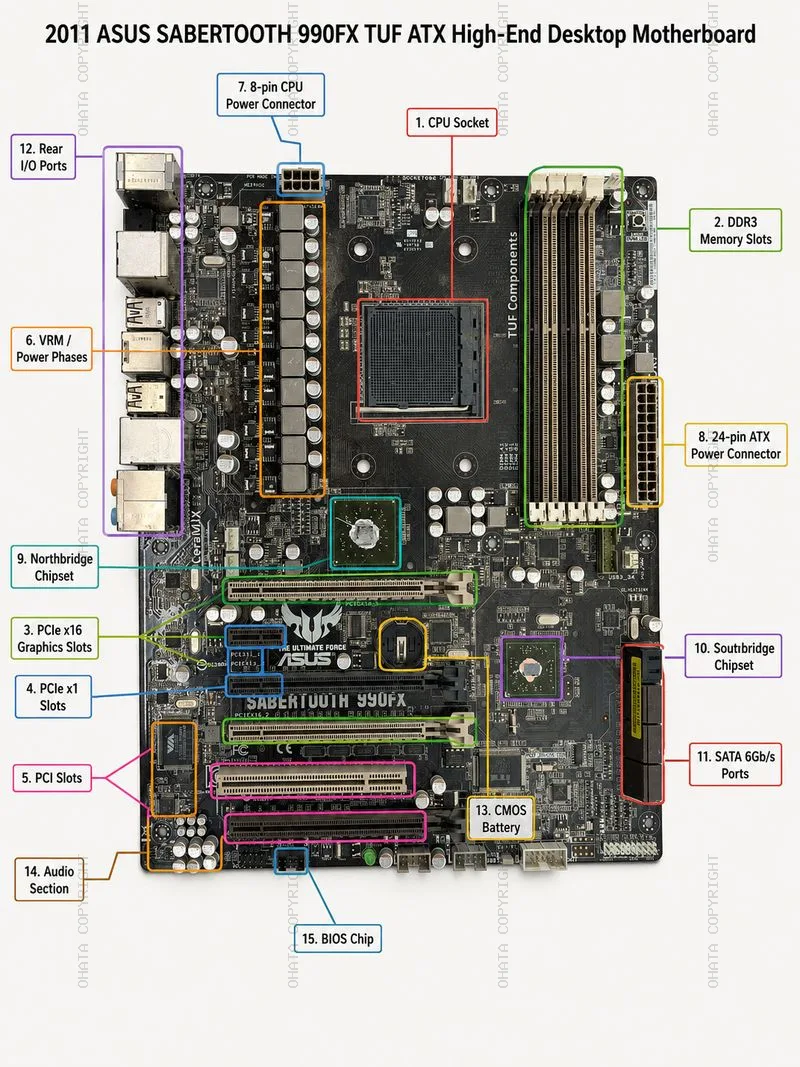
2011 asus sabertooth 990fx tuf atx high end desktop motherboard scrap identification Show All
Key visual identifiers include:
- ASUS logo and TUF emblem
- Printed model marking: SABERTOOTH 990FX
- AMD AM3+ CPU socket in the upper center
- Four DDR3 DIMM slots on the right side
- Multiple PCIe x16 expansion slots in the lower half
- Black SATA ports on the right edge
- Large VRM power phase area beside the CPU socket
- AMD 990FX northbridge chip below the CPU socket
- AMD SB950 southbridge chip in the lower-right region
- ATX 24-pin power connector and 8-pin CPU power connector
For recycling inspection, the board should be checked from both sides. The front side contains most of the high-value components. The back side mainly contains solder joints, copper routing, through-hole connections, socket retention structures, and rear I/O solder points. The back side is still part of the recoverable PCB, but the highest-value scrap features are concentrated on the component side.
CPU Interface and Processor Support
The SABERTOOTH 990FX uses an AMD Socket AM3+ CPU interface. This is a PGA-style processor platform, meaning the CPU itself has pins and the motherboard socket contains the pin holes and locking mechanism. The CPU socket is a ZIF, or zero insertion force, socket. In practical scrap identification, this means the socket appears as a square black plastic grid with a side locking lever. It is different from Intel LGA sockets, where the pins are in the motherboard socket instead of on the CPU.
The AM3+ socket on this board is intended for AMD FX Series processors up to 8 cores and is also compatible with certain AMD AM3 processors, including Phenom II, Athlon II, and Sempron 100 Series processors, depending on BIOS support and processor compatibility. This compatibility is important for recycling because some boards may arrive with a processor still installed. If a CPU is present, it should not be removed roughly or by force. Bent or broken CPU pins can reduce resale or recovery value.
The required CPU interface type is:
- CPU socket: AMD Socket AM3+
- Socket style: PGA ZIF socket
- Pin count class: AM3+ / Socket 942 class
- Typical supported CPU package size: approximately 40 mm × 40 mm
- Processor families: AMD FX, AMD Phenom II, AMD Athlon II, AMD Sempron 100 Series
The CPU package size requirement is important for physical inspection. AM3+ desktop processors, such as AMD FX series CPUs, use a square integrated heat spreader package commonly treated as approximately 40 mm by 40 mm. When identifying the socket area, the board should show a square socket large enough to accept this class of desktop AMD PGA processor. A missing CPU does not make the motherboard valueless, but a board with an intact socket and an installed recoverable CPU generally has higher scrap or resale potential than a stripped board.
Memory Interface
The SABERTOOTH 990FX contains four DDR3 DIMM memory slots. These are full-size desktop memory slots, not laptop SO-DIMM slots. The board supports dual-channel DDR3 memory. The physical DDR3 slot notch position prevents DDR or DDR2 memory from being installed correctly. For scrap sorting, the presence of four intact DIMM slots is significant because memory slots contain metal contacts and may include gold plating.
Key memory identification details:
- Memory type: DDR3 SDRAM
- Slot type: 240-pin desktop DIMM
- Number of slots: 4
- Channel mode: Dual-channel
- Typical supported speeds: DDR3 1066, 1333, 1600, 1866, and higher overclocked profiles depending on CPU and memory module compatibility
- Maximum memory class: commonly listed up to 32 GB across four slots
If memory modules are still installed, they may be sorted separately depending on the recycling workflow. Functional DDR3 modules may have reuse value, while non-working modules still contain gold-plated edge fingers and IC packages. If the RAM slots are damaged, melted, cracked, or missing, the motherboard should be downgraded because the board has lost a recognizable connector group and some recoverable contact material.
Graphics and Expansion Interfaces
This motherboard does not contain a soldered dedicated GPU chip. Graphics capability is provided by removable graphics cards installed into PCI Express x16 slots. This is a major distinction from many gaming laptop motherboards, which often include a soldered NVIDIA or AMD GPU. On the SABERTOOTH 990FX, the graphics-related scrap area is the PCIe x16 expansion section rather than an onboard GPU BGA package.
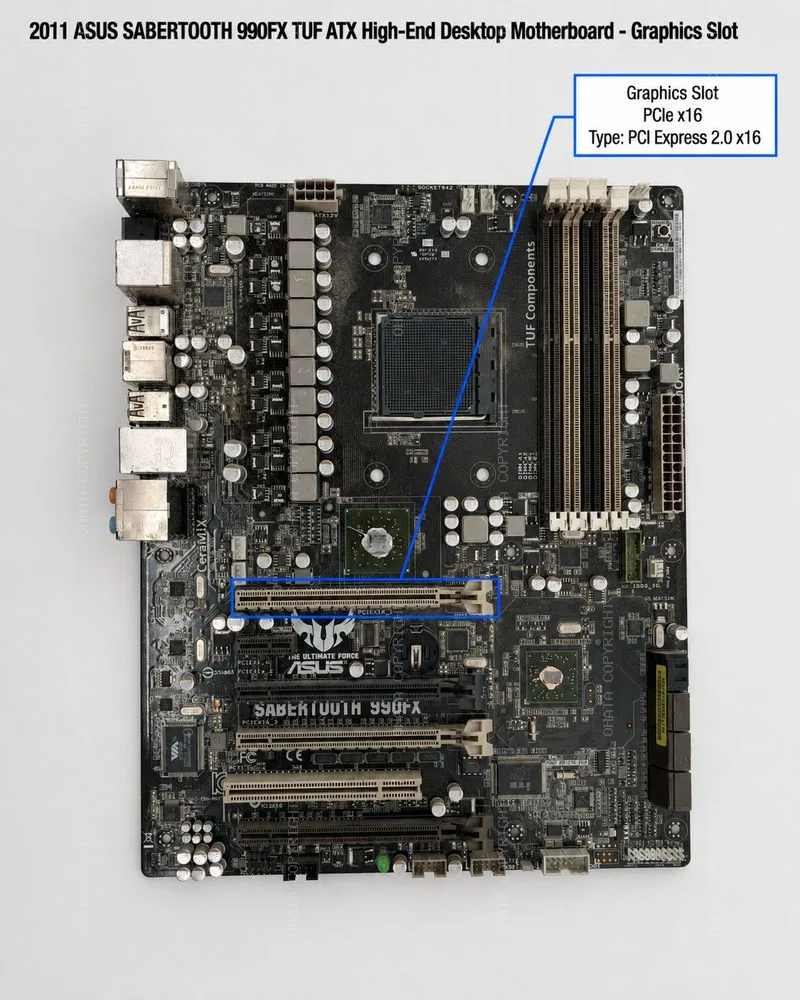
2011 asus sabertooth 990fx tuf atx high end desktop motherboard scrap identification PCIe x16
The board includes multiple expansion slots, including PCIe 2.0 x16 slots for graphics cards, a PCIe x1 slot, and a legacy PCI slot. The primary graphics slot is the upper PCIe x16 slot. In multi-GPU systems, the board supports SLI and CrossFireX configurations, depending on the installed cards and operating mode.
Key expansion details:
- Primary graphics interface: PCI Express 2.0 x16
- Graphics card support: removable desktop PCIe graphics cards
- Multi-GPU support: NVIDIA SLI and AMD CrossFireX class configurations
- Other slots: PCIe x1 and legacy PCI
- No onboard dedicated GPU BGA chip: graphics processing depends on add-in cards
From a scrap perspective, PCIe x16 slots are useful because they contain long rows of metal contacts. The gold-plated contacts in expansion slots contribute to recovery value. Boards with broken PCIe slots, missing slot housings, or burned expansion areas should be downgraded. If a graphics card is still installed, it should be removed and graded separately unless the recycling stream specifically accepts complete assemblies.
Chipset Architecture
The board uses the AMD 990FX chipset platform with a separate northbridge and southbridge design. The northbridge is the AMD 990FX chipset, and the southbridge is the AMD SB950 chipset. These are BGA semiconductor packages mounted directly to the motherboard. In the inspected board, the heat sinks have been removed, exposing the chipset packages and visible thermal compound residue. Exposed chipsets can still be acceptable if the BGA packages remain physically attached, but removed chipset ICs are a serious value-reducing condition.
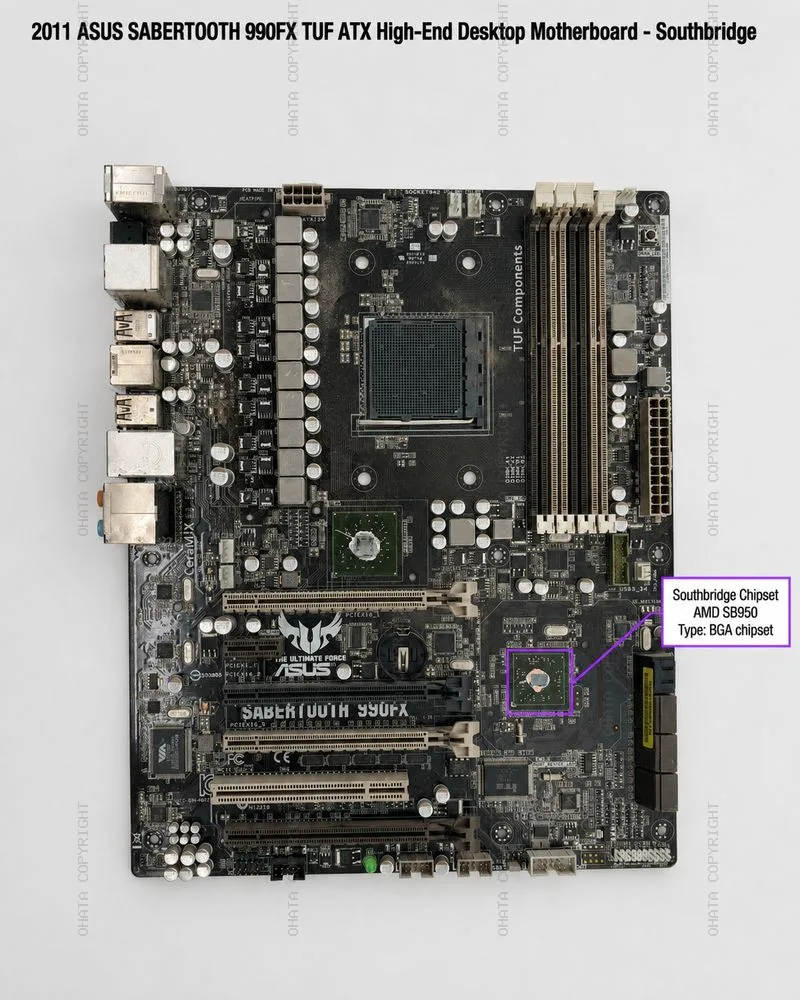
2011 asus sabertooth 990fx tuf atx high end desktop motherboard scrap identification GBA Chipset
The AMD 990FX northbridge supports the platform’s high-speed I/O architecture, including HyperTransport connectivity and PCI Express graphics lanes. The SB950 southbridge handles storage, USB, SATA, and other peripheral functions. Together, these chips are among the most important integrated circuit packages on the motherboard.
Important chipset areas:
- Northbridge: AMD 990FX
- Northbridge package type: BGA chipset
- Southbridge: AMD SB950
- Southbridge package type: BGA chipset
- Function: PCIe, storage, USB, peripheral control, platform I/O
For scrap acceptance, both chipset packages should remain on the board. A motherboard with removed northbridge or southbridge ICs should be downgraded or rejected depending on the buyer’s grading rules. Heat sinks may be missing, but the underlying chips should not be removed. If the BGA pads are exposed where a chipset was removed, the board has lost a key semiconductor component and likely falls into a lower grade.
Storage Interfaces
The SABERTOOTH 990FX uses SATA storage connectors rather than SCSI, IDE, or M.2. The visible storage connectors are grouped along the right edge of the board. The SB950 southbridge platform supports SATA 6Gb/s storage and RAID configurations. SATA connectors are lower in precious metal content than CPU sockets or memory slots, but they remain useful for identification and contribute small amounts of recoverable metal through contacts and soldered connections.
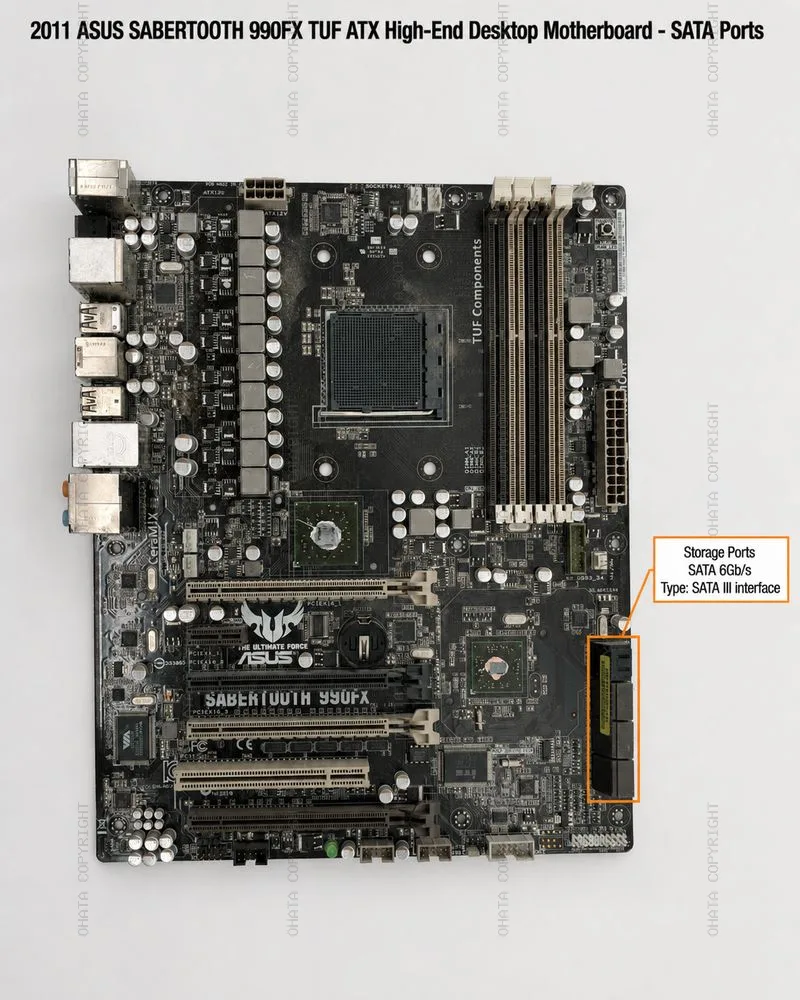
2011 asus sabertooth 990fx tuf atx high end desktop motherboard scrap identification SATA III
Storage identification details:
- Main storage type: SATA
- Interface class: SATA III / SATA 6Gb/s
- RAID support: RAID 0, RAID 1, RAID 5, and RAID 10 class configurations
- Connector location: right edge of the motherboard
- No native M.2 connector on this 2011 desktop board
Because this is an older desktop motherboard, it should not be expected to include modern NVMe M.2 slots. A recycler should identify it as a SATA-era high-end desktop board. If SATA ports are broken, missing, or burned, the board can still retain value through the CPU socket, chipset packages, PCIe slots, and PCB, but the condition should be noted.
Power Delivery and VRM Section
One of the most visually significant areas of the SABERTOOTH 990FX is the VRM power section beside the CPU socket. This area includes power phases, MOSFETs, chokes, capacitors, and driver circuitry used to regulate voltage for the CPU and related platform components. The board is widely associated with an 8+2 phase power design class, reflecting its high-end desktop positioning.
The VRM section is important for scrap because it contains copper-rich inductors, aluminum or polymer capacitors, MOSFET packages, and other power-management ICs. These components contribute to both material recovery value and board grade. A dense VRM section is one of the reasons this board is more attractive than lower-end desktop boards with smaller power delivery areas.
Key VRM and power features:
- CPU VRM area beside the AM3+ socket
- Multiple chokes and MOSFET packages
- Solid capacitor groups
- 8-pin CPU power connector near the top edge
- 24-pin ATX power connector on the right edge
- Power-management ICs and supporting circuitry
Burned VRMs, missing inductors, stripped MOSFETs, or cracked power connectors can reduce value. Complete and intact VRM assemblies help preserve the board’s grading quality.
Rear I/O and External Connectors
The rear I/O section is located along the left edge of the motherboard. This area contains metal-shielded external ports and is useful for both identification and scrap recovery. Typical rear I/O for this board class includes USB ports, USB 3.0 ports, PS/2 keyboard/mouse combo port, optical S/PDIF output, eSATA, IEEE 1394a, RJ-45 Ethernet, and audio jacks, depending on revision and rear panel configuration.
External connector groups contain a combination of steel shells, copper contacts, nickel plating, and sometimes small amounts of gold plating. The individual value of each port is limited, but the group contributes to the overall motherboard grade. Boards with rear I/O intact are easier to identify and sort than boards with ports removed.
Important rear I/O and controller-related components include:
- USB 2.0 and USB 3.0 ports
- RJ-45 Ethernet port
- Audio jacks
- Optical S/PDIF output
- eSATA and IEEE 1394a class rear connections
- Realtek gigabit LAN controller class
- Realtek 8-channel HD audio controller class
- VIA IEEE 1394 controller class
If rear I/O ports are missing, heavily corroded, or cut off the PCB, the board should be downgraded. For most standard recycling streams, ports should remain attached unless a component-level recovery process is being used.
BIOS, CMOS Battery, and Support ICs
The board includes a BIOS flash chip, CMOS battery holder, clock circuitry, Super I/O controller, network controller, audio controller, USB controllers, and other small integrated circuits. These parts may not dominate the board’s scrap value individually, but they support identification and contribute to the total integrated circuit content.
The BIOS chip is a small flash memory device used to store firmware. The CMOS battery holder contains a coin cell used to maintain system settings. In recycling preparation, coin-cell batteries should be handled according to battery recycling rules and may need to be removed before shipment if required by the receiving facility.
Support components include:
- BIOS / flash ROM chip
- CMOS battery and battery holder
- Super I/O controller
- Audio codec
- LAN controller
- USB controller circuitry
- Fan headers and sensor circuits
- Front-panel and internal USB headers
These components are important in visual grading because a complete motherboard with all support ICs intact is generally preferred over a stripped board.
Accepted Scrap Condition
A SABERTOOTH 990FX motherboard is generally more desirable as scrap when it remains complete and recognizable. The board does not need to be functional, but it should retain the main semiconductor packages, slots, connectors, and power components.
Generally acceptable conditions include:
- Non-working but complete motherboard
- AM3+ CPU socket intact
- DDR3 memory slots intact
- Northbridge and southbridge chipsets still attached
- PCIe and PCI slots still attached
- SATA ports present
- Rear I/O ports present
- VRM components present
- BIOS chip and support ICs present
- Minor dust or normal aging
- Missing removable CPU or RAM, if the socket and slots remain intact
A board with its CPU and RAM removed can still be graded as motherboard scrap. However, it is usually less valuable than a complete board with recoverable CPU or memory modules included.
Not Accepted or Downgraded Conditions
Certain conditions can reduce the value of the motherboard or cause rejection, depending on the recycling program. The most serious issue is removal of chipset ICs or other major BGA packages. When the AMD 990FX northbridge or AMD SB950 southbridge is removed, the board loses a key high-value semiconductor component and becomes harder to classify as complete high-grade desktop motherboard scrap.
Common downgrade or rejection conditions include:
- Removed northbridge chipset
- Removed southbridge chipset
- Removed major BGA ICs
- Broken or cut PCB
- Fire damage
- Severe water damage or corrosion
- Missing CPU socket
- Removed memory slots
- Removed PCIe slots
- Stripped VRM inductors or MOSFETs
- Excessive plastic, steel, or non-electronic waste mixed with the board
- Oil contamination or chemical contamination
- Loose garbage packed with the shipment
- Attached lithium batteries or swollen batteries from other devices
Heat sinks may be removed, but the chipsets underneath should remain attached. A board with exposed thermal paste is acceptable only if the semiconductor package is still present and undamaged. If the chip itself has been desoldered, the board should be treated as incomplete or downgraded scrap.
Scrap Value Factors
The scrap value of this motherboard depends on completeness, component density, visible gold-bearing contacts, chipset condition, and current recycling market conditions. It is not valued like a modern working motherboard unless it is being sold for reuse or repair. For material recovery, the main value drivers are the PCB grade and attached components.
Major value factors include:
- Complete ATX PCB with internal copper layers
- Intact AM3+ CPU socket
- Installed CPU, if present
- Four intact DDR3 DIMM slots
- Gold-plated contacts in memory and PCIe slots
- AMD 990FX and SB950 BGA chipsets present
- Dense VRM section with copper inductors
- Rear I/O connector stack
- SATA and internal headers
- BIOS and controller ICs
- Clean, dry, non-corroded condition
Factors that reduce value include missing semiconductor chips, removed sockets, broken slots, missing connector groups, burned areas, contamination, or mixing with low-grade scrap.
Scrap Grade Assessment
The 2011 ASUS SABERTOOTH 990FX should generally be viewed as a higher-end desktop motherboard scrap item rather than a low-grade appliance board. It is not the same category as server motherboards, telecom boards, or dense laptop gaming boards with soldered CPU and GPU packages. However, within the desktop motherboard category, it is stronger than many office PC boards because it has a large ATX format, multiple PCIe x16 slots, a dense power section, and two major BGA chipset packages.
Suggested scrap classification:
- Category: High-end desktop motherboard scrap
- Platform: AMD AM3+ desktop
- PCB type: Multi-layer ATX motherboard PCB
- Value class: Above average desktop board, below server/telecom-grade boards
- Best condition: complete, dry, chipsets intact, slots and connectors intact
- Downgraded condition: missing CPU/RAM but main board complete
- Rejected or heavily downgraded condition: removed chipset ICs or severely damaged PCB
Preparation Tips for Recycling
Before shipment or sorting, the board should be kept dry, clean, and physically intact. Loose screws, plastic brackets, unrelated cables, and batteries from other devices should be removed. If CPU, RAM, or expansion cards are present, they may be separated and graded individually, depending on the recycler’s process. However, unnecessary stripping of sockets, chipsets, slots, and small ICs should be avoided because it can reduce the board grade.
Recommended preparation steps:
- Keep the board dry
- Avoid bending or cutting the PCB
- Do not remove chipset ICs
- Do not remove PCIe or memory slots
- Remove loose non-electronic waste
- Separate heavy heat sinks if required by the buyer
- Remove coin-cell batteries if required by battery handling rules
- Pack boards flat to prevent cracking
- Separate desktop motherboards from laptop boards and low-grade appliance boards
- Identify boards with removed BGA chips before quoting
Proper preparation improves grading consistency and reduces disputes during receiving inspection.
Why This Board Matters in Scrap Identification
The SABERTOOTH 990FX is useful as a reference board for high-end desktop motherboard scrap because it clearly shows the major component groups that recyclers evaluate: socketed CPU area, memory connectors, PCIe graphics expansion, chipset packages, VRM power circuitry, rear I/O, SATA storage, BIOS, and PCB construction. Its layout makes it easier to explain why complete boards are more valuable than stripped boards.
The most important rule for this board is component integrity. The CPU may be absent, and memory modules may be absent, but the socket, chipsets, slots, and connector groups should remain attached. Removed chipset ICs, missing sockets, broken slots, burned power areas, and contaminated boards can significantly reduce value.
For scrap buyers, this motherboard should be identified as a 2011 AMD AM3+ ATX high-end desktop motherboard with DDR3 memory support, PCI Express 2.0 x16 graphics-card slots, SATA 6Gb/s storage ports, AMD 990FX/SB950 chipset architecture, and a dense TUF-series power and thermal design. In complete condition, it is a strong desktop motherboard scrap item. In stripped or damaged condition, it should be downgraded according to the missing components and physical condition.